Throwback hand-painted billboards line the miles along I-90 in South Dakota, advertising free ice water, 5-cent hot coffee and homemade doughnuts. The nostalgic teasers build anticipation for travelers bound for the Badlands, Mount Rushmore and Yellowstone National Park, pulling toward Wall Drug Store.
The roadside attraction in Wall, South Dakota, is a bucket-list stop and a family tradition — a fourth-generation enterprise packed full of nostalgia, where 76,000 square feet of retail include 26 shops under one roof.
For most visitors, Wall Drug is a stop on the way to somewhere else. But for many, it becomes something they return to. And while the Main Street outpost has grown over time, the building itself has not changed much.
Photos: Ryan Becker
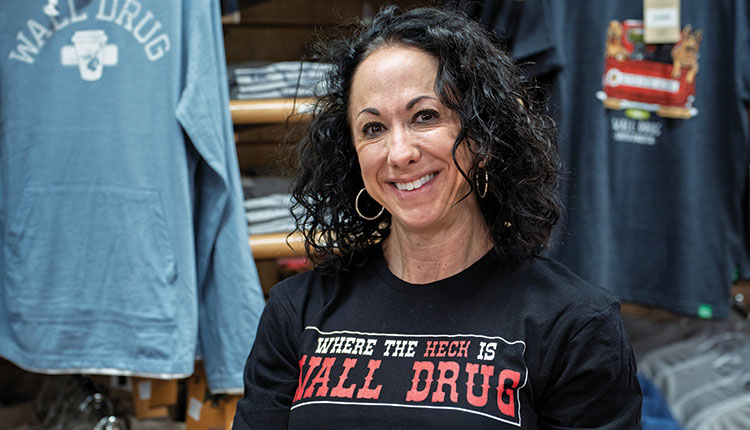
“Visitors come here and they want to step back in time,” says Jackie Kusser, executive buyer and receiving supervisor.
The ice water’s still free and there have been no inflation price hikes for the nickel coffee.
These tried-and-true niceties date back to when founders Ted and Dorothy Hustead opened in 1931 as a hometown pharmacy with some convenience items. Today, Wall Drug draws millions of visitors each year, with peak summer days bringing up to 20,000 people through its doors.
While billboards may be the hook, the magic inside is what has turned this South Dakota store into a roadside legend — and a masterclass in souvenir retail.
What’s in store
Wall Drug is one stop with many shops carrying more than 100,000 SKUs, estimates Kusser, who has spent more than 25 years shaping the product assortment.
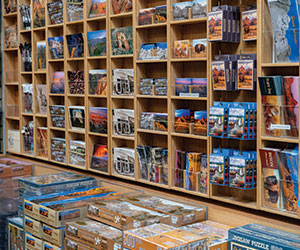
Visitors can find a bookstore, jewelry counters, a 700-style boot department, western wear, rock shops,
souvenir shelves and a camping store area. Of course, there’s a pharmacy that keeps the operation true to its roots.
But within the Wall Drug “compound,” visitors can also find refreshments at the soda fountain, taste sweets from its doughnut factory or dine at a massive cafe surrounded by one of the country’s largest privately owned collections of Western art.
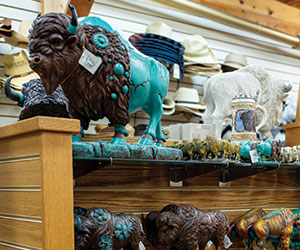
Some souvenirs promote native wildlife like bison.
Outside, the experience continues. The Backyard blends retail with entertainment — mining stations, a shooting gallery, photo ops and a giant jackalope — giving families space to explore while extending the shopping journey.
The longer people stay, the more they discover and the more opportunities there are to convert a stop into a sale. Signage and simple paper maps help guide customers around the complex.
And with an influx of tourists during the busy season between Memorial and Labor Day, shoppers are often navigating crowds, moving quickly and making decisions on the fly. Kusser’s goal is to make that process as easy as possible.
Within Wall Drug’s stores, products are grouped by type: walls of mugs, rows of magnets, dedicated hat sections so customers can quickly find what they’re looking for without overthinking the experience.
“We want to make it easy for them,” she says, relating that items are categorized by price point, too. For example, stickers, magnets, keychains and other small purchases are displayed together, while higher-end brands like Demdaco figurines are situated with similar products.
“We are definitely known for customers walking out and saying, ‘The prices are better here than other places,’” Kusser says. “We take pride in that. We want our souvenirs to be affordable.”
Going along with the free ice water, accessible souvenir pricing is part of the charm. Kusser says, “We want to give people a happy experience, and we want them to walk out with something in their hands they can feel good about.”
Nostalgia sells
Aside from a cost-conscious buying approach, Kusser says consistency is key. Despite the scale, Kusser’s buying philosophy is grounded in restraint and not “what’s new.” The focus is meeting customers’ expectations because by the time they arrive, the signs have already told them what Wall Drug is — and what it isn’t.
“Visitors have an idea in their heads of what they will find,” says Kusser. “We try to maintain our nostalgia.”
And what they are is old-school.
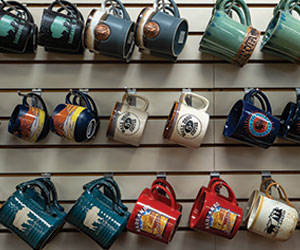
Name-drop and souvenir mugs are a big category for Wall Drug, with many options hanging on display in the store.
So Kusser sticks with motifs and familiar, natural color schemes. “We choose products in neutral tones like white, cream and brown, and we may throw in some orange and green,” she relates, adding that some red mugs join the assortment “but even a red mug is risky.”
“It’s a different climate in this region when it comes to buying,” says Kusser, calling out wildlife motifs including buffalo and western themes. Jackalopes interest visitors because of their regional lore.
A basic diner-style mug with a brown wrap logo has been the store’s top-seller for decades. “It’s simple and people like that,” Kusser says.
Name drop is also a focus, with Wall Drug’s brand recognition driving sales in apparel, hats, mugs, magnets, blankets, stuffed animals and more. These join Badlands and Black Hills logoed items.
Rarely will Kusser deviate from the Wall Drug norm.
“We’ve worked with our vendors for so many years and they know our store,” she says, citing these relationships as a rewarding part of her role. “It’s such a team effort.”
The Wall Drug way
Selling more souvenirs for lower prices requires strategic ordering and constant stocking, along with a team that works like a well-oiled machine.
Kusser aims to receive all product shipments between January and May. She places re-orders as needed during the busy summer months. This means most ordering happens September through December.
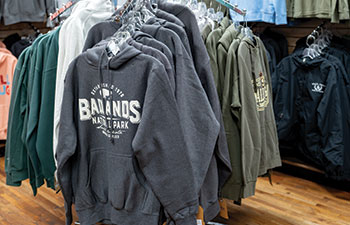
Some souvenirs promote nearby national parks and attractions.
Souvenirs arrive by the semi-truck load and are hand-sorted by Kusser and her team, who use pricing guns to tag every item with a good, ‘ole “sticker price.” Using paper and pen, Kusser personally compares receivables to invoices to check that orders were accurately fulfilled.
Throughout the season, the team maintains a steady rhythm of restocking, guided by daily walkthroughs and constant communication.
“We tried to implement at POS system, but we have too many SKUs and we don’t have the labor for it,” says Kusser, explaining how products are rung up at the register by price, not item number. “So, we don’t get a report that says, ‘You sold this many, time to reorder.’”
But estimating inventory needs based on what Kusser knows about what works is also the Wall Drug way. “It’s natural for us,” she says.
As for people, Wall Drug jumps from about 50 full-time employees in the off-season to up to 200 during prime time.
“Many are ‘work campers,’ so they live in their campers and travel to national parks in the area to work,” Kusser explains.
Though even when the store’s labor force is at a seasonal high, the Wall Drug culture is still “small town vibes,” says Kusser.
And rather than chasing what’s next, Wall Drug continues to prove the staying power of consistently following the Wall Drug way.
For Kusser, that’s what makes the job special. “It’s like being part of a big family.”