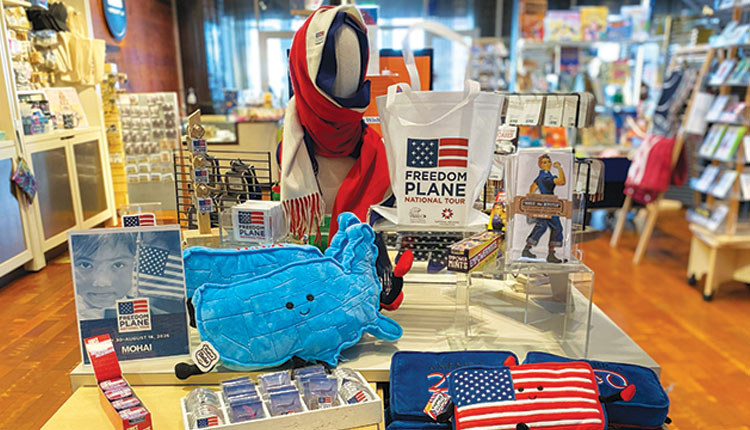
When a landmark traveling exhibition honoring America 250 presents a moving retail opportunity, collaboration across gift shops is the key to pulling off just-in-time product orders, planning pop-up shops and staffing for an unexpected surge in visitors.
Just ask Stacie Ford-Bonnelle, mercantile manager at the Museum of History & Industry (MOHAI) in Seattle, one of eight stops on the national Freedom Plane tour, which also includes National WWI Museum & Memorial in Kansas City, Missouri; Atlanta History Center in Atlanta; University of Southern California Fisher Museum of Art in Los Angeles; Houston Museum of Natural Science in Houston; History Colorado in Denver; Museum of Miami in Miami; and Henry Ford Museum of American Innovation in Dearborn, Michigan. The experiential exhibit is bringing original founding-era documents to cities across the country.
MOHAI is the final destination on the eight-stop Freedom Plane tour and one of two West Coast locations. Across the country, the exhibit offered museum gift shops an unprecedented opportunity to learn, adapt and refine what an America 250 retail experience could be.
“We’re excited we were considered,” Ford-Bonnelle relates. On Jan. 20, she learned of MOHAI’s grand finale slot, July 31 to Aug. 16.
Positioning matters. With each city hosting the exhibition for about 16 days and a rapid turnaround in between, retailers were learning from one another in real time — while also planning for significantly higher traffic.
“We are all holding hands,” says Ford-Bonnelle of the few months leading up to the exhibition and connecting with retail managers at previous stops as their Freedom Plane exhibits departed to the next stop. “We’ve had great conversations, and we’re all sharing what’s working and figuring it out together.”
Retail relay
MOHAI’s first move was reaching out to other participating museums. Ford-Bonnelle says she also tapped into the Museum Store Association network, talking with retailers and vendors.
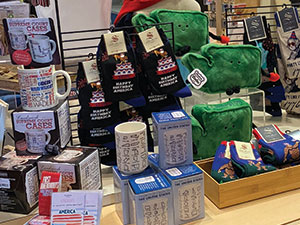
MOHAI features souvenir displays for America 250.
“The WWI Museum in Kansas City was the first stop, and it was all new to them,” Ford-Bonnelle says. “They really helped us wrap our brains around what to expect and sent us pictures of their pop-up.”
Estimating attendance was part of the challenge. Ford-Bonnelle says MOHAI typically welcomes about 400 people daily and is planning for about 2,000 guests a day or more during Freedom Plane.
Collaboration extends to product, too. While early hopes included a fully traveling merchandise assortment, logistics and institutional differences shifted the strategy. Instead, stores are sharing insights — and, in some cases, inventory.
“We’ve done that in the past with traveling exhibits,” Ford-Bonnelle notes. “If something works in one location, there may be an opportunity to bring that into the next.”
At the National WWI Museum and Memorial, the tour’s first stop, a trial-and-error approach paid off quickly. “We were taking our best educated guesses,” says Brooke Leisinger-Smith, director of guest services. “This was our first pop-up, and we weren’t sure what to expect.”
Leisinger-Smith worked with the National Archives to source Freedom Plane merch. “I also called the New York Historical Society and other sites that sell products like this more regularly,” she says, noting that institutions supplied lists of vendors and top-selling products.
At the WWI museum, high-performing items included Freedom Plane-branded merchandise, replica documents, pins, patches and postcards — many of which sold out within the first weekend.
Unexpected winners also emerged.
“Founding father finger puppets were wildly successful,” Leisinger-Smith says, along with novelty items from Unemployed Philosophers Guild that appealed to kids and adults.
Local layers
Each museum gift shop on the Freedom Plane tour is telling a same yet different story based on the location and context of its collections.
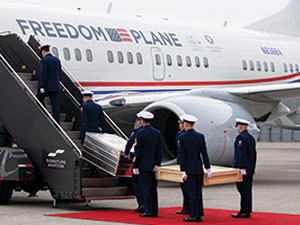
The Freedom Plane carried founding-era documents to eight museums across the U.S., including the WWI Museum in Kansas City.
At MOHAI, the museum is using retail and America 250 to expand the narrative beyond traditional perspectives and include its racial equity workplan. The MOHAI store is working with local organizations, artists and retailers to bring in merchandise that reflects a wider range of voices and experiences.
MOHAI regularly partners with local businesses — from bookstores to record shops — to curate themed assortments tied to exhibits. For Freedom Plane, Ford-Bonnelle reached out to indie bookstores to help shape book selections and storytelling.
“We’re able to highlight other businesses while offering products we might not typically carry,” she relates.
At History Colorado, Retail Manager Kendall Goduto also layered a local lens into the national moment. Its May 28 to June 14 Freedom Plane stop coincided with Colorado’s 150th anniversary and the campaign The Moment That Made Us. “We are a centennial state, created on the 100th anniversary of the founding of America,” she explains.
A commission developed merchandise that honors both milestones, including a zip-up hoodie, T-shirts, hats, mugs and stickers.
For Freedom Plane, Goduto focused on souvenirs that align with the exhibit itself, such as feather pens and bald eagle plush.
“I met with Stacie at MOHAI and Brooke at the WWI museum, and Stacie shared her product list, so we definitely borrowed from that,” says Ford-Bonnelle.
Flexible format
If there’s one constant across Freedom Plane retailers, it’s flexibility. MOHAI’s modular fixtures like slat walls and movable displays allow for quick shifts based on demand. The team is planning phased product rollouts, adding new merchandise in waves leading up to the exhibition.
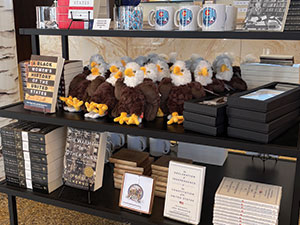
History Colorado showcases bald eagle plush alongside some relevant reads and souvenir mugs.
“We’ll ramp up over time and adjust based on what we’re seeing,” Ford-Bonnelle says.
She’s staying in close contact with other cities on the tour to refine MOHAI’s approach. By the time the exhibition reaches Seattle, MOHAI will have insights from multiple stops.
If certain items underperform elsewhere, MOHAI may opt out. If others sell quickly, the team can reorder or source additional inventory.
And beyond product, MOHAI is preparing for a surge in visitors — potentially five times its typical daily traffic.
With lines expected to extend into the surrounding park, the store becomes part of the experience. “People can come into the shop while they’re waiting,” Ford-Bonnelle says.
That creates opportunities for impulse purchases and deeper engagement, especially with interactive and family-friendly items.
“It will be interesting to see what people get excited about and what they want to take home,” she says.
For retailers, that’s the ultimate takeaway. Freedom Plane isn’t just a traveling exhibit — it’s a live test of how storytelling, collaboration and merchandising intersect at scale.
And for MOHAI, the opportunity is as much about learning how to execute just-in-time retail as it is about selling souvenirs and gifts that visitors can take home as mementos.
“We’re going to showcase what we do best,” Ford-Bonnelle says.