Jewelry might not take up much real estate in a zoo gift shop, but don’t underestimate what a little bling can do.
At the Saint Louis Zoo, Retail and Visual Manager Tommy Brown estimates jewelry occupies just 8 square feet of selling space at its flagship shop. Yet based on the revenue it generates per square foot, the category is highly productive.

Guests can peruse a spinning rack at the Saint Louis Zoo’s flagship store for a variety of nature- and animal-themed necklaces, bracelets and earrings.
“From this perspective, it makes the most money of anything we really have in the zoo,” says Brown.
While jewelry might not command the volume of other souvenir staples, retailers say the category is consistent, versatile and capable of reaching an unusually wide range of shoppers.
At Northwest Trek Wildlife Park in Eatonville, Washington, Store Director Amy Campbell sees children buying mood rings with their own money, families selecting fun animal-themed pieces and guests with a conservation focus gravitating toward jewelry that supports a cause.
“They can get an animal on it that reminds you of the zoo, but it’s also something that is lasting,” she says.
The common denominator? Give customers plenty of reasons to wear their wild side.
Bling for all
Brown says the Saint Louis Zoo’s jewelry customer can be 10 years old or 80. “Jewelry speaks to everyone, and it’s personal to an individual,” he says.
The Saint Louis Zoo relies on rack programs from vendors including Barry-Owen Co. and Cool Jewels for fashion jewelry. Brown notes that those programs have dependable margins.
The zoo layers in specialty jewelry from other makers along with conservation-focused products such as Fahlo animal-tracking bracelets and Melissa Lew. Price points generally range from about $10 to $20 on the lower end and $25 to $50 for higher-end merchandise.
At Northwest Trek, accessibility is especially important. “You want everyone to have an experience and come away with something,” Campbell says. “Having affordable souvenirs is a plus. Span the price range.”
The strategy can also encourage a return purchase. Campbell hears parents helping children choose between two items with a promise that perhaps they can get the other one next time.
At Turtle Central Gift Shop located at the Bald Head Island Conservancy on Bald Head Island, North Carolina, Amy Dunmire, business manager of retail, considers price, trends and how well a line fits the shop’s coastal aesthetic when buying jewelry.
Current lines include Pura Vida, Lotus and Luna, World Imports, Charming Shark and The Beach and Back.
Lotus and Luna was such a strong seller this summer that Dunmire was down to about eight pieces after a full restock.
The Beach and Back’s charm jewelry has also found a broad audience. Dunmire says, “Those have been really popular with the 20-somethings all the way up to grandparents.”
A story to wear
At a zoo, aquarium or conservation attraction, an animal pendant or bracelet can connect them to the zoo’s purpose.
This is particularly evident with Fahlo bracelets at Northwest Trek and its sister facility, Point Defiance Zoo & Aquarium. The red wolf bracelet carries an even more direct local connection.
Point Defiance has participated in red wolf recovery efforts since the 1970s, and proceeds from the bracelet benefit the Association of Zoos and Aquariums’ SAFE American Red Wolf program. “It ties into what we are doing and what the guests are helping with by even coming to the zoo,” Campbell says.
Turtle Central has an equally strong opportunity to connect merchandise with mission. The gift shop serves as both the welcome and exit point for visitors to the Bald Head Island Conservancy, whose work includes an internationally recognized Sea Turtle Protection Program.
The Beach and Back created a Bald Head Island collection featuring sea turtle earrings, necklaces and bracelets, with proceeds supporting the conservancy’s sea turtle protection work and other initiatives. Each piece sold also funds the collection and recycling of a half-pound of ocean-bound plastic.
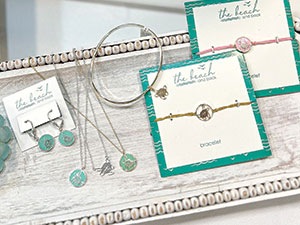
The Beach and Back created a line of sea turtle earrings, necklaces and bracelets just for the Bald Head Island Conservancy.
Turtle Central keeps this jewelry collection together, along with a card explaining the give-back story. Cutout sea turtle earrings and necklaces, along with coin pieces, have been among the strongest performers.
At Saint Louis Zoo, Brown considers vignettes and themes essential when merchandise has a mission attached to it.
If a jewelry line supports wildlife conservation, a community or another cause, Brown advises retailers to say so at the display. “Messaging and storytelling is very important in jewelry because it’s personal,” he says.
Show off the sparkle
Of course, even jewelry with a great story has to get noticed. For Brown, that starts with making every square foot work hard. “You really want to maximize your floor space,” he says. “Always think of spinner racks.”
A spinner provides four merchandising surfaces while occupying relatively little floor space. Brown designs his own fixtures and has them manufactured by KC Fixtures. A newer double- spinner design offers more selling surface along with storage underneath.
Extra storage comes in handy when jewelry is turning three to five times annually.
Walls can also work, and Brown is adamant about one merchandising essential: light it up. “Lighting is your most important thing in jewelry,” he says. He recommends bright LED lighting, combining floods to wash the area in light with spots directed at pieces that sparkle.
At the Saint Louis Zoo gift shop, higher-end rings from local, woman-owned R.S. Covenant are presented in display cases and illuminated to bring out the shine.
Lower-priced fashion jewelry can be packed more tightly onto a spinner. Walls provide less selling capacity per square foot, he notes, but allow retailers to direct lighting more precisely.
At Turtle Central, most jewelry occupies an area that flows into body care, accessories and women’s apparel, creating natural adjacencies as customers shop. But Dunmire is willing to break the category apart for demographic’s sake.
Case in point: Charming Shark jewelry geared toward high school- and college-age shoppers was moved into the kids’ section. The result was immediate. “Once we moved it there, it flew off the spinner,” she says.
An emotional connection
Perhaps jewelry’s greatest advantage is that it can outlast the day that inspired the purchase. Campbell sees it during field-trip season when one child buys a necklace and suddenly friends want matching ones. She remembers buying mood jewelry herself when she was younger.
Brown sees the same emotional connection play out across generations. Mothers and daughters spot pieces they could wear together. Teenage boys approach the register with rings for girlfriends — sometimes discovering they have no idea what ring size they need.
Brown and his team help them figure it out, and those interactions are part of what makes jewelry different from many other souvenirs. “Jewelry is very personal, and it means something when you give it to someone,” Brown says.
A ring bought during a childhood zoo trip might still be tucked into a jewelry box more than a decade later.
This staying power is difficult to measure by square footage alone. And it might be jewelry’s brightest selling point. As Brown says, “We create those memories so they can take a piece of that memory home from the gift shop.”