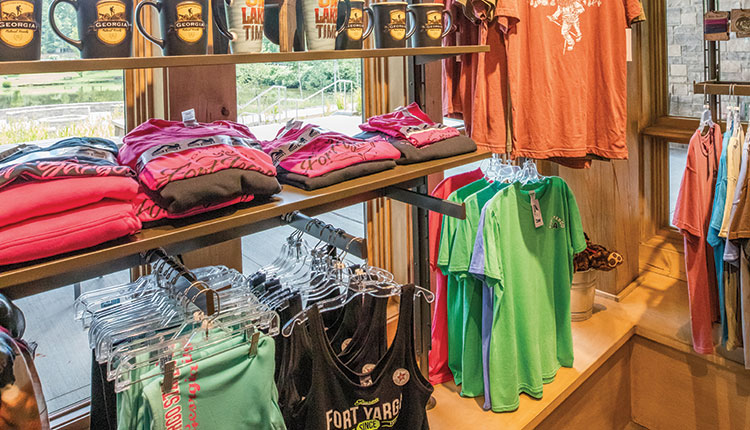
When visitors arrive at a state park, their focus is often on exploring trails, historic sites and scenic views. But for many, a trip isn’t complete without a keepsake — a piece of apparel that captures the experience and becomes a wearable memory. At Cape Disappointment State Park in Washington and Fort Yargo and Vogel state parks in Georgia, retail stores are curating clothing lines that blend functionality, quality, and storytelling, reflecting local culture and practical needs.
Balancing history and practicality
Perched at the mouth of the Columbia River, where Lewis and Clark concluded their famous expedition, Cape Disappointment State Park operates two retail locations: one at the Lewis and Clark Interpretive Center and another near the North Head Lighthouse.
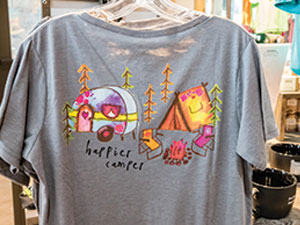
Georgia’s Fort Yargo offer a variety of colors and designs to appeal to a wide range of visitors.
Manager Carla Winston describes the stores’ mission: “Our shop specializes in the history and culture of the Pacific Northwest. We have a tremendous amount of history and story of what life was like in the Pacific Northwest including living by the Columbia River as well as the Pacific Ocean.”
The stores’ apparel selection mirrors that dual focus on history and practicality. Visitors can find long- and short-sleeved T-shirts, hoodies, wind and rain jackets, youth T-shirts, ball caps, beanies, and Wildthings’ Junior Ranger apparel, including vests and bucket hats. Popular colors like teal, dark olive, and cardinal red tie to the local landscape and park branding.
Winston notes that weather-appropriate items, particularly wind and rain jackets, are consistently bestsellers: “Our wind and rain jackets are very popular because of the weather we have up here. This year I chose the teal color… and a new dark olive color — good colors for the Pacific Northwest.”
Long-sleeved T-shirts have also surged in popularity, reflecting a broader trend among park visitors. Winston scouts emerging trends at the Las Vegas Souvenir & Resort Gift Show, supplementing that insight with on-site observations: “I look to see what people are wearing and asking for.”
By combining trend-spotting with customer feedback, the stores keep their selections relevant while staying true to their historical and cultural themes.
Beyond utility and style, apparel serves as a tangible reminder of the visit. “People come to our shop not only to look for the Lewis and Clark experience but they also want the lighthouse souvenir, and because we are at the mouth of the Columbia River, they want that big wave picture,” Winston says. Clothing becomes a lasting memento of place and experience.
Quality and connection
At Vogel State Park and other Georgia state parks, a similar philosophy of connecting visitors to the park through apparel is embraced.
Terry Miller, division retail manager, Georgia State Parks & Historic Sites, describes the stores’ guiding principle as “re-telling through retail,” offering interpretation alongside high-quality souvenirs.
“We offer items at various price points to ensure there is something for everyone in each store,” Miller explains.
Vogel’s apparel includes long- and short-sleeved T-shirts, hoodies, sweatshirts, jackets, hats, and name-dropped merchandise, as well as Wildthings’ Junior Ranger apparel that engages younger visitors. Dark greens and browns dominate the color palette, reflecting the park’s natural environment.
Emerging trends at Vogel echo those seen in Washington. “Customers are buying more long-sleeved shirts, apparel with UV Protection and moisture-wicking materials. Visitors are looking for higher quality merchandise and are willing to pay for a better product,” Miller notes.
Apparel now represents 22% of retail sales, the park’s largest product category, underscoring its importance for both revenue and visitor engagement.
Making decisions
Shaun McCardell, owner of Lone Rock Clothing, a wholesaler supplying apparel to parks and resort stores, emphasizes that park shoppers often make decisions based on color, design and feel, rather than price.
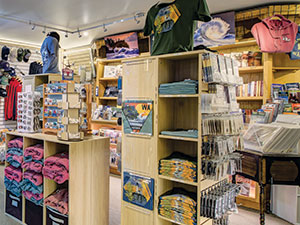
Cape Disappointment State Park retail stores ensure their apparel channels the area’s history.
“Customers will walk into their predetermined locations… the first thing that catches their eye has got to be a color… then design, and then it’s feel,” McCardell explains. This insight aligns with both Cape Disappointment and Vogel’s strategies, where carefully chosen colors and designs drive sales.
McCardell also observes a cyclical nature in trends: simple, lightweight clothing is returning, and color palettes fluctuate between muted and bright tones. Accessories — hats, caps, and small items — are also increasingly important, reflecting visitor desire for functional yet memorable products.
Approaches and trends
While Vogel emphasizes interpretive storytelling and quality across a broad demographic, Cape Disappointment balances historical narrative with weather-ready apparel. Both parks report rising popularity of long-sleeved shirts and specialized outerwear, responding to practical visitor needs. Thoughtful attention to color, design, and quality ensures that clothing enhances the park experience without detracting from it.
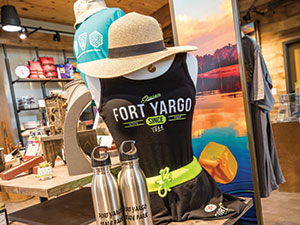
Fort Yargo State Park in Georgia blends functionality, comfort and memorabilia into its apparel selection.
Whether it’s a cardinal red hoodie embroidered with lighthouses or a UV-protective T-shirt commemorating a Vogel hike, apparel serves a dual purpose: connecting visitors to the landscape while providing a tangible memory.
As Miller reflects, “It helps promote our site and keep the memories of their visit going for years to come.”
Winston echoes this sentiment. “Our visitors want souvenirs that reflect the park, the lighthouse, and the Columbia River — they want something they can take home that reminds them of their experience.”
As these parks illustrate, apparel is more than merchandise — it is an extension of the experience. Thoughtful design, quality materials and attention to emerging trends allow park stores to meet visitor expectations while supporting educational and interpretive goals.