Visitors arrive at the Museum of the American Revolution in Philadelphia expecting history — the familiar figures and well-known stories of the nation’s founding, from George Washington to the Declaration of Independence.
But what they experience is more immersive and personal. Inside the museum’s galleries, the Spirit of 1776 unfolds through everyday people, untold accounts and artifacts that take guests back in time. Here, history feels personal and, more than ever, so does the retail experience.
Following a significant museum renovation and ahead of the nation’s 250th anniversary, the museum has also reimagined its gift shop, restaging it as an extension of the stories told throughout the building.
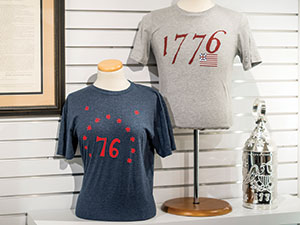
Bust forms highlight souvenir tees, some that celebrate the Spirit of 1776 and others that detail the importance of patriotic women.
Photos: JPG Photography
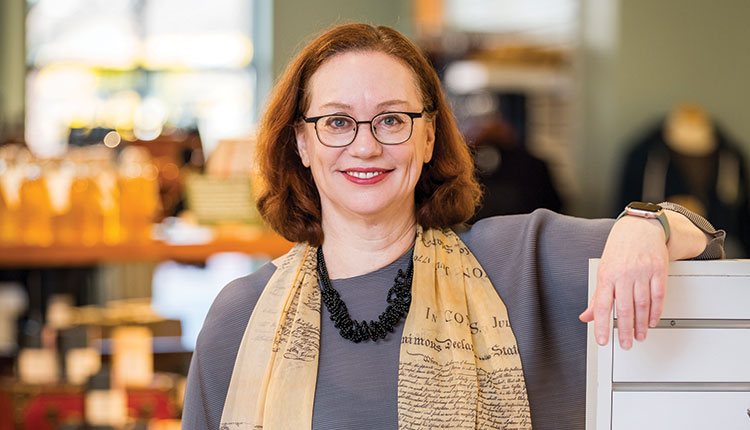
At the center of this evolution is Allegra Burnette, chief strategy and growth officer, whose background spans museum design, digital strategy and a decade as creative director of digital media at the Museum of Modern Art (MoMA) in New York City. Her focus: aligning retail with mission, experience and storytelling.
“We’ve been telling the 250 story since our opening in 2017,” Burnette points out, acknowledging that the milestone birthday “means we get to lean into what we already do a bit more.”
At the same time, the newly designed store reflects a broader purpose — one where retail connects to its collection and supports the museum’s mission well beyond the anniversary. Burnette says, “We don’t want that to take away from the fact that this is important information and context next year and years after that.”
Designed to connect
The museum’s exhibits have been described as “a film you can walk through,” with immersive elements that highlight the Revolutionary era.
Burnette says many of these Revolutionary era stories carry into the museum store. The spirit of independence is echoed in the museum’s new approach to retail. The store has transitioned to an in-house operation, giving the team agency over product selection, storytelling and partnerships.
“It reinforces a seamless visitor experience,” says Burnette.
With increased visitation expected around America 250, the museum saw an opportunity not just to expand retail, but to refine it, which fast-forwarded the shop’s reorganization strategy.
The transformation involved trading some spaces within the museum. The family discovery center was relocated. This change reduced the store’s footprint from roughly 3,000 square feet to a more focused 1,590 square feet.
The result? A shop that performs better at a smaller scale.
The relocated store captures guests as they exit the galleries, creating a natural transition from experience to purchase.
Curating collections
Rather than organizing merchandise by product type, displays align with the exhibits visitors encounter, allowing the gallery experience to continue in a tangible way in the shop. A display focused on founders, for example, expands beyond the familiar figures to include voices like Phillis Wheatley and others whose contributions are often less visible.
George Washington has a dedicated presence, anchored by the museum’s signature artifact — his original field tent — with merchandise that ties back to one of the institution’s most powerful experiences.
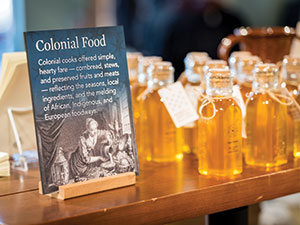
Revolution Bees Wildflower Honey is available for purchase and provides a taste of colonial history.
Within these categories, the museum has formed creative partnerships with vendors to develop exclusive products. For example, an exhibit telling stories of revolutionary influencers includes insight about Christopher Ludwick, baker general for the Continental Army. The museum store enlisted House on the Hill, a cookie mold maker to reproduce a gingerbread mold artifact just like the ones featured in its collection.
“Shane Confectionery, a candy store around the corner, made cookies in the mold, so we marry those products on the shelf to tell a multi-layered story,” Burnette describes.
Other collaborations follow a similar path.
Tyson Frantz of nearby Liberty & Co. has been an important creative voice and contributor to the museum shop’s apparel and gift offerings. “He is designing products for us and also connecting us with partners and helping facilitate those relationships,” Burnette says.
Artisans who have previously crafted props for museum exhibits are now creating handcrafted toys and goods for retail. Designers, makers and museum staff work together to translate historical references into modern products, often building entire assortments around a single theme.
Meanwhile, these partnerships allow the museum to extend its narrative beyond the gallery walls while supporting a network of creators who bring those stories to life, which is important in a neighborhood dense with historic sites and souvenir shops, Burnette points out.
“We are located right by the Betsy Ross House and The National Constitution Center, and there are about a half dozen souvenir shops within a block of us,” says Burnette. “So, we’re very much focused on how we can celebrate our stories and this America 250 moment in a way with retail that is not what everyone else offers.”
Products that represent
Indeed, differentiation is key and familiar motifs are interpreted in authentic ways. For example, a well-known Revolutionary slogan like “Join, or Die” becomes “Unite or Die,” a variation drawn from the museum’s collection and translated into handmade ceramics by a small-batch pottery partner and apparel by Liberty & Co.
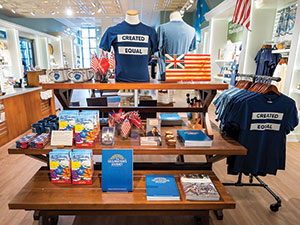
Carefully curated store displays with books, T-shirts and mugs feature common themes from throughout the museum.
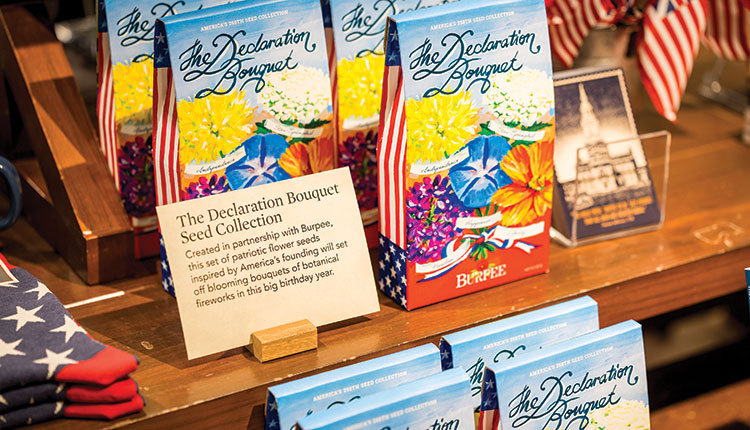
For America 250, the strategy is similar. Rather than just stocking commemorative merchandise, the museum is treating the anniversary as an entry point. (See sidebar, “
Seeding Sales for 250")
“We’ve been telling these stories all along,” Burnette reiterates. “This just gives more people a reason to engage with them.”
And offering ways for all guests to experience what’s in store is also a priority, she adds, noting how the shop’s product selection includes a range of price points to serve a diverse audience. School groups with limited budgets browse alongside collectors seeking higher-end items.
“We consider all of these avenues when sourcing products for the store because we want everyone to feel like there’s something here they can take back home to remember their visit,” Burnette says.
Behind every item is a layer of institutional review. A cross-departmental “product working group,” including curatorial, education and leadership teams, evaluates products to ensure alignment with the museum’s voice and values.
“It’s not just about what sells,” Burnette says. “It’s about what represents us.”
Beyond experience and merchandising, the shift to an in-house model benefits the museum’s mission. Revenue generated by the store flows directly back into the museum, supporting exhibitions, programming and collections.
“There’s a real opportunity here,” Burnette says, noting that a robust, new online shop is in the works to reach an even wider audience.
With America 250 in focus, the museum’s retail operation is also celebrating a milestone and entry into the next era.
The story extends from the gallery exit into the museum store, Burnette relates. “It’s not just about what people take home,” she says. “It’s about what stays with them: the stories, the connections and the understanding that this history is still unfolding.”