With its beautiful, expansive views and miles of hiking trails, Grand Canyon National Park is one of the most visited of the 63 U.S. national parks. According to the National Park Service, just over 4.9 million people visited the Grand Canyon in 2024. Arizona’s iconic mile-deep canyon is a natural marvel that many people enjoy seeing at least once in their lifetime.
When people come from all over the country and abroad to visit this park, a stop in the South Rim Visitor Center for information as they start their trip is usually a must. Upon completion of their canyon exploration, those same visitors often stop back for a souvenir at the visitor center’s Grand Canyon Park Store.
Operated by Grand Canyon Conservancy, the Grand Canyon Park Store’s team of 40-plus employees serve more than just souvenirs to the millions of people who visit every year.
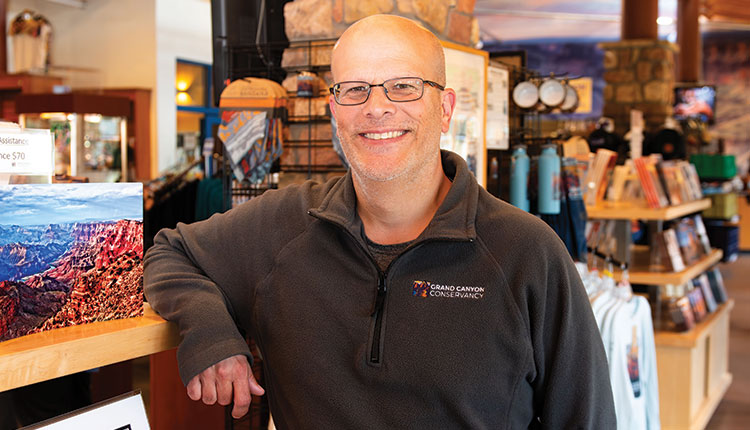
“We’re an extension of the park,” says Duncan Petrie, associate director of operations at Grand Canyon Conservancy, explaining that he and his team are prepped to provide hiking and travel advice to visitors.
The gift shop pairs some name-drop tees with hats.
Photos: Gabby Wallace
Petrie says he and his team regularly provide guests with details on how long different hikes might take, trail suggestions and tips on other nearby attractions.
In addition to being great hosts, Petrie says the Grand Canyon Conservancy’s gift shops provide necessary funding for the park. In 2024, Grand Canyon Conservancy brought in $17.8 million in retail revenue, with at least 10% of the revenue going back to the park. Buying a souvenir magnet or T-shirt from one of the conservancy’s gift shops ultimately gives back to park functions.
“The Grand Canyon’s Junior Ranger program is still free, and retail helps to fund that,” he shares. “We have a brand new cultural demonstration center at Desert View, and retail helped to fund that. A bridge at the park was damaged by floods, and retail helped to pay for the repair of the bridge.”
Retail revenue has also helped to fund essential services, such as an on-site ambulance and other resources for emergency rescue efforts at the park.
“I love the mission and working for a nonprofit, supporting the park,” Petrie says. “Nature is a really important thing to protect. It’s a healing tool for a lot of people. Although we’re in a gift shop setting, realistically what we’re doing is raising money for the park, providing funds to support it for the future.”
More space for mementos
Originally known as the Grand Canyon Natural History Association, the Grand Canyon Conservancy began in 1932 as a park partner organization. The conservancy opened gift and book shops at the park as a way to support it.
In the past, these shops primarily focused on books and educational materials. Today, Petrie says the gift shops still focus on offering educationally relevant items, but the product mix has truly expanded to incorporate more mementos — T-shirts, hoodies, plush, magnets and even some hiking essentials.
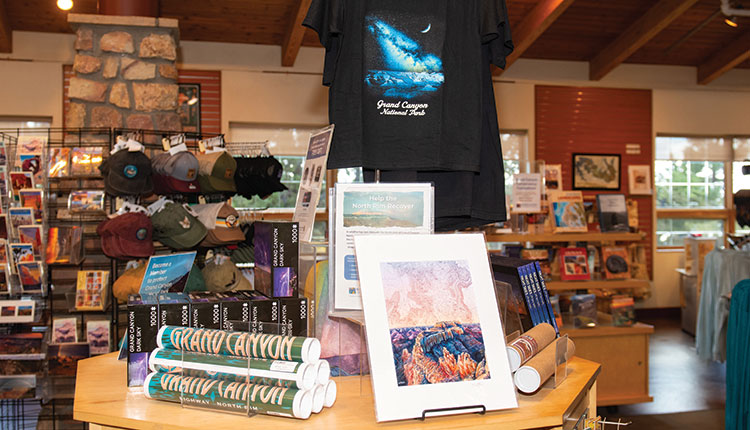
Lately, apparel is a popular category for Grand Canyon Conservancy’s gift shops. A main section in the South Rim Visitor Center store features rolled shirts and a rounder for hanging garments, with some additional apparel items cross-merchandised with other items to showcase different collections in store.
Petrie says traditional name-drop T-shirts do well, and some hikers especially enjoy quick-drying T-shirts that they can wear on their hike. All the apparel includes the Grand Canyon name drop on it.
Headwear is also a hit with customers of all ages, with the conservancy gift shops featuring a mix of traditional “dad” caps as well as trucker hats, beanies and bucket hats. Magnets are also a popular souvenir pick at these park stores.
On top of expanding its souvenir mix, Grand Canyon Conservancy has also recently expanded its physical footprint at its main South Rim store. The nonprofit oversees six gift shops around the Grand Canyon National Park, with five on the South Rim and one on the North Rim.
“The main store on the South Rim does about 57% of my business,” he explains. “That’s our newest building. We built it in 2000.”
More recently, Petrie and his team saw an opportunity to add 300 square feet to the 4,000-square-foot space, with a goal of improving merchandising presentation at the shop. The nonprofit completed the buildout in the fall of 2025.
“It gives us the ability to bring in more products,” says Petrie. “By creating more space, we can add more interpretive marketing and information next to products to tell more of a story.”
Sincere selections
Storytelling is important with all merchandise at Grand Canyon Conservancy’s gift shops. Petrie explains that all products must be approved by the National Park Service’s chief of interpretation, ensuring that every souvenir aligns with the park’s mission and features themes and motifs that truly relate to the park.
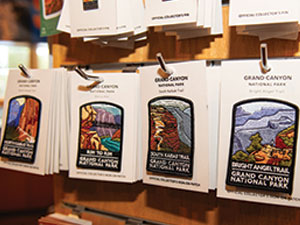
Practical souvenirs, like patches they can put on hiking apparel. appeal to hikers visiting the Grand Canyon.
Many customers enjoy products with the canyon imagery and other geology themes. Petrie adds that some items feature native wildflowers and cacti that can be found in the park, along with a few of the animals that reside there such as mule deer and mountain lions.
Products made by local tribal artisans can get the green light to be sold in Grand Canyon Conservancy gift shops, with tribes native to the park including Havasupai, Hopi, Hualapai, Kaibab Band of Paiute Indians, Las Vegas Band of Paiute Indians, Moapa Band of Paiute Indians, Navajo Nation, Paiute Indian Tribe of Utah, San Juan Southern Paiute Tribe, The Pueblo of Zuni and Yavapai – Apache Nation.
“We’re also trying to expand our options of indigenous products,” says Petrie. “We were able to partner with a Hopi artist and use his design on a shirt, Nalgene bottle and decal. He is paid a royalty on the sales of these items. We also purchase pottery, baskets, word carvings and jewelry from local indigenous artists.”
Providing support
In 2025, national parks across the U.S. faced concerns about budget cuts. Petrie says retail’s role in providing for the park certainly increases in importance anytime the federal government cuts back on funding for the parks.
Then in July, the Dragon Bravo Fire spread throughout the Grand Canyon National Park and led to the closure of the North Rim. Several buildings on the North Rim, including a Grand Canyon Conservancy store, were destroyed because of the fire. The conservancy reports that the fire was contained as of Sept. 29, 2025, and there has been limited access to the North Rim since then. Petrie adds that he’s unsure as to whether the store and other buildings on the North Rim will all be rebuilt.
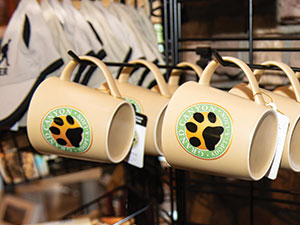
Products in the conservancy gift shops depict wildlife that is actually seen around the Grand Canyon, such as mountain lions and mule deer.
The federal government shutdown in the fall also impacted parks across the U.S. Mindy Riesenberg, chief communications officer for Grand Canyon Conservancy, says the Grand Canyon Conservancy helped to provide $48,000 in funding to ensure that essential Science and Resource Management projects on the North Rim could still be completed.
While the North Rim was temporarily closed, the South Rim remained open the entire time and was unaffected by the Dragon Bravo Fire. Petrie says he and his passionate team at the Grand Canyon Conservancy remain ready to help and support the park any way it can in this time of need. Although park visitation declined during the fires and government shutdown, donations and giving back to the park increased.
Petrie attributes the Grand Canyon Conservancy’s success over the years to his loyal team members, too.
“All operations come down to the people and having an awesome team around you,” he says. “It takes an army of people to get things done, so we need to have the right people here with the same level of passion for the parks.”