Blue Whale of Catoosa welcomes travelers to new visitor center and gift shop |
| By Kristen Hampshire |
|
|
Iconic Route 66 landmark has delighted travelers for over 50 years.
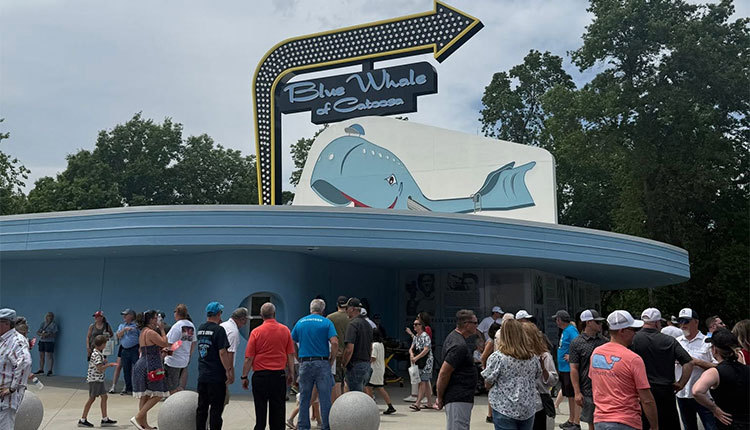 The Blue Whale of Catoosa, one of the country’s most recognizable Route 66 landmarks, is welcoming travelers to a new 4,000-square-foot visitor center and gift shop as interest in America’s Mother Road maintains its momentum amid the Route 66 centennial. The facility officially opened May 30 and represents a significant investment in preserving and promoting the northeastern Oklahoma attraction that has delighted travelers for more than 50 years. Floor-to-ceiling glass walls tell the story of the Blue Whale and the family behind it, while a compact gift shop offers visitors a colorful assortment of souvenirs inspired by the roadside icon. “We don’t expect this to be the big year,” says Jennifer Buchanan, director of visitor services for Catoosa. “We expect this to be the beginning year.” She thinks renewed interest in the 2,448-mile highway ignited by its 100th birthday will inspire people to take the trip for years to come. And the Blue Whale’s new visitor center is positioned to serve the masses. “There’s been so much publicity about Route 66 and how much fun everyone’s having that it has become ‘the trip to take,’” says Buchanan. A splashy storyThe Blue Whale back story is even more fascinating than the semi-truck-sized cartoonish whale itself. Built in 1972 by zoologist Hugh Davis, the 20-foot-tall, 80-foot-long whale began as a project for his grandchildren to enjoy in a pond on the family’s property. Over the decades, it has become an enduring symbol of Route 66 and a bucket-list stop for generations of road trippers. But the Blue Whale’s story extends far beyond the landmark itself. “The Blue Whale is just an amazing story, and I think that’s what connects so many people to it,” Buchanan says. “This destination actually started long before the Blue Whale.” 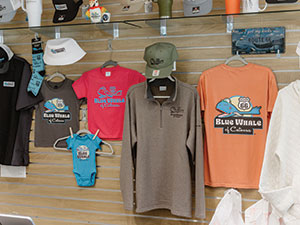 A wall of apparel for all ages is on display at the Blue Whale of Catoosa gift shop in Oklahoma. Hanna Taylor Hugh and Zelda Davis once operated an animal park on the property. The attraction included everything from alligators and baby lions to a now-empty snake pit that once relied on its unique curved design to keep its residents contained. Zelda, a Cherokee woman known for her bright red hair and signature turquoise jewelry, greeted travelers along Route 66 while educating them about animals. After retiring from a 38-year career with the Tulsa Zoo, Hugh Davis decided to build something special for his family. It took two years and countless five-gallon buckets of hand-mixed cement to complete the massive structure. By coincidence, the project was finished on the couple’s wedding anniversary. “He told her, ‘I’ll give you something no woman has,’” Buchanan quips. “What started as a family project ended up being this iconic roadside attraction on Route 66.” Something different in storeToday, the attraction is experiencing a revival of attention as travelers rediscover Route 66. Buchanan says the site regularly welcomes tour buses, motorcycle groups and car cruises, with some weekends drawing between 7,000 and 12,000 visitors. The visitor center’s retail component, though modest at just over 400 square feet, has quickly become a destination in its own right. Buchanan intentionally took a different approach after researching other Route 66 gift shops. “When I started looking at the gift shops, I realized so many of the shops had the exact same stuff,” she says. “They’re all just going down the route, so many of the shops had the exact same things. We wanted a very different look.” That philosophy is evident throughout the space. Instead of relying on the blacks, grays and whites common in many souvenir shops, the Blue Whale gift shop embraces bright hues, including turquoise, coral, yellow and a custom shade known internally as “Blue Whale Blue.” Popular items include Richardson 112 hats, stickers, magnets, tumblers and a heathered sage green T-shirt that has emerged as an unexpected bestseller. The store has also found creative ways to maximize its footprint. T-shirts are rolled and secured with rubber bands before being displayed in cubbies, making them easy for travelers to browse and pack for the journey ahead. “I did it because I didn’t have a lot of space,” Buchanan says. “But visitors have actually really liked it. They’re travel ready.” For Buchanan, however, the visitor center and gift shop are ultimately about preserving a piece of Americana and sharing it with a new generation of travelers. “Our shop isn’t the biggest part of the experience,” she says. “It’s not the big star. The Blue Whale is. Our job is to tell that story, celebrate the history and give people one more reason to stop along Route 66.” |
