Smart store flow, themed groupings and strategic resets turn toy and game displays into discovery zones.
Merchandising is all fun and games when store layout turns browsing into discovery.
For Sam Rickenbaugh, owner of The Great Rocky Mountain Toy Company in Bozeman, Montana, this philosophy is rooted in a lifetime surrounded by retail. His mother owned a high-end home decor and gift shop, and his father operated a sporting goods store. Growing up around retail, merchandising and customer relationships became second nature.
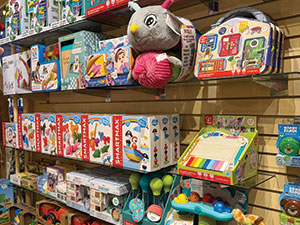 Rocky Mountain Toy Company displays kits on a wall. After working in real estate, he learned the longtime downtown toy store he had visited as a child was for sale and stepped in to continue its 30-plus-year legacy. Today, his connection to the toy store shapes how he thinks about layout, product storytelling and creating a space where customers stick around and return to rediscover favorites and find games.
Inside the classic toy shop, the categories are clear but the path is anything but direct. This is on purpose. Rickenbaugh places destination brands with intention — especially LEGO, which lives at the back of the store.
“We want customers to walk through the entire store and ‘ooh’ and ‘ahh’ at everything else before they get to what they came for,” he says.
Merch mixRocky Mountain Toy Company groups merchandise by type and then by brand. “When you look at a section, you’re looking at one category,” Rickenbaugh says. “Within that category, you see the brand you know and love in the middle, with other brands around it to create a story.”
Games, for example, are arranged so shoppers immediately recognize the store as a game destination for all play styles and ages.
The mix reinforces the store’s identity as a place for family game night, college friend groups and serious hobbyists alike, a key factor in a market where Montana State University students join local families as core customers.
Rickenbaugh makes sure store displays appeal to a crowd, especially considering the store’s biggest competitors are Amazon and Target. But because of the experience Rocky Mountain Toy’s displays deliver, it’s tapping into a “new generation that is shopping in person for toys,” says Rickenbaugh. “We see more people trying to shop local and shop in-store.”
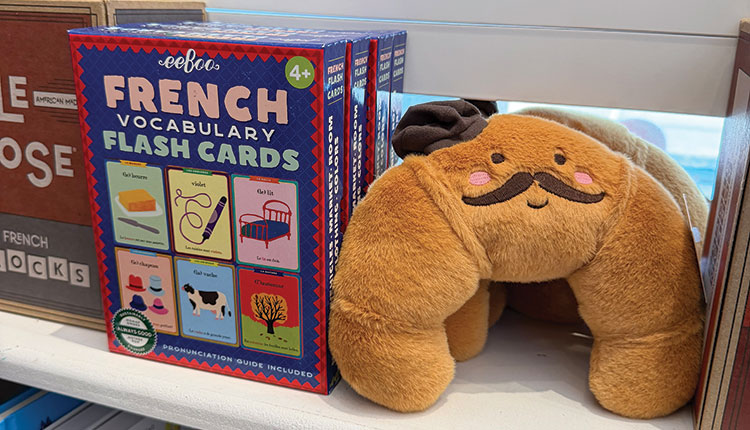
This is also the case at Pebbles Toys & Gifts in New Haven, Connecticut, where a Yale campus constituency will pop in for a specialty toy in its educational language-learning section. Theme-based merchandising is key in the 960-square-foot shop, says Lauren Coleman, store manager.
“We set up our store not by age but by section,” she says, also avoiding brand-based displays because she wants to introduce guests to products they won’t find in a big box store.
With anchor toy-and-game displays centered on topics like science, pretend play, crafts, heirloom toys and learning, Coleman also features seasonal motifs, such as spring or holiday.
“We are looking for diversity,” she adds, relating that associates lean in to customers’ remarks and requests. These conversations guide buying choices and product placement in the shop.
“When you’re putting something out, you have to think about what’s behind you, next to you and on the other side,” says Coleman. “It needs to be the same customer.”
Variety showMerchandising with an adjacency-by-category state of mind at Pebbles Toys & Gifts means microscopes and STEM toys share space with books about space and microorganisms.
The section balances price points, too, from a showstopping telescope to small grab-and-go kits. This way, every shopper finds an entry point. Enticement is the merchandising ticket. “Our displays are colorful and we only put a couple of each item out at a time,” says Coleman.
Materials and aesthetic also matter. Coleman favors sustainable brands and heirloom-quality designs that feel special and gift-worthy.
For instance, craft kits by Djeco and Mindware are positioned with Tender Leaf pretend play sets. Always thinking motif, Coleman might build a display with a craft kit of fair potions, a fairies matching game, books and plush.
“You can really make stories here,” she says.
Reset button Merging themed storytelling with carefully placed brand focal points is the merchandising strategy at Tate & Tilly in Tampa, Florida.
Owner Amy McDermott notes that “Jellycat stands alone.” The plush brand’s display standards mean the assortment lives together in a defined area with cubby storage and oversized statement pieces. Placement is strategic: the Jellycat section is toward the back of the store, encouraging customers to travel through gift, decor and accessory displays along the way.
McDermott also favors cross-category merchandising. “It’s all about gifts, gifts, gifts,” she says. “I want customers moving from one display to the next, adding items as they go.”
She knows that static shelves can lose sales. This is why she refreshes displays by simply relocating products.
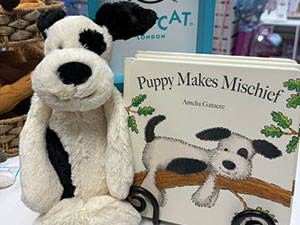 Tate & Tilly pairs a puppy plush with a puppy book for add-on sales. Rickenbaugh also works toward major store resets every few months. While he likes to group brands together with defined sections, giving customers a category at a time to view, these periodic shifts allow for working in new items and repositioning others.
Since at least 60% of customers are returning multiple times, the layout and display refreshes are crucial for capturing attention at every visit. It’s about staying on top of trends while carrying the old favorites,
Rickenbaugh says.
Merchandising as a cohesive shop-within-a-shop that includes dedicated areas for toys, games, plush, infant and tween gifts has given Tate & Tilly’s customer base a connection to the store, no matter their age and stage.
McDermott adds that fun and games can be for everyday and all occasions as long as they’re displayed to sell.
|